The normal high in Kansas City is 38 degrees in January and 88 in July, according to NOAA. The court is the same size in both months. Playing on it is not the same sport. This guide takes indoor tennis in Kansas City one month at a time, separates what a roof really changes from what it does not, and says plainly when a park court is the smarter choice.
Kansas City month by month: when does indoor win?
Five months favor indoor courts, five favor the park, and two are a toss-up. The chart plots NOAA's 1991 to 2020 climate normals for Kansas City International Airport. Watch the low line drop under the freezing line for three months, then watch July's high come within two degrees of the 90-degree band.
- days a year at 90°F or hotter
- 36
- days a year that never get above freezing
- 26
- days a year with measurable rain or snow
- 104
1991 to 2020 normals, Kansas City International Airport, from NOAA. Day counts are the annual normals, rounded.
Check your own month
Pick the month you actually play. The colors follow a simple rule, set out under the tool, and the green months are an honest reason to skip the club and use a park court.
Pick a month. See what Kansas City does to your tennis.
January in Kansas City
Indoors, clearly.
Normal highs sit in the 30s and 40s and some days never get above freezing. This is the stretch of the year a roof is for.
- Normal high
- 38°F
- Normal low
- 20°F
- Days at 90°F or more
- 0
- Days that stay at or below 32°F
- 10.3
- Days with rain or snow
- 6.8
Numbers are the 1991 to 2020 normals for Kansas City International Airport from NOAA, so a Blue Springs afternoon can differ by a few degrees. The colours are our rule of thumb, not an official rating: indoors when the normal high is under 45°F or ten or more days reach 90°F, outdoors when the normal high is 60°F or more and hot days stay under ten, either in between.
Playing this month?
Live availability for our four indoor tennis courts. You do not need a membership to book.
The cold months: December through February
From December through February a normal Kansas City day tops out between 38 and 44 degrees, and the high never gets above freezing on about 23 days of the winter. In January the overnight low is at or below freezing on about 27 nights.
A park court is still playable on a mild afternoon, and a few winter days are lovely. The trouble is that you cannot plan around a few. Cold weeks in a row make a weekly lesson, a league night or a standing doubles game impossible to schedule outdoors, and those are the things that make you better.
What it means for lessons, leagues and standing games
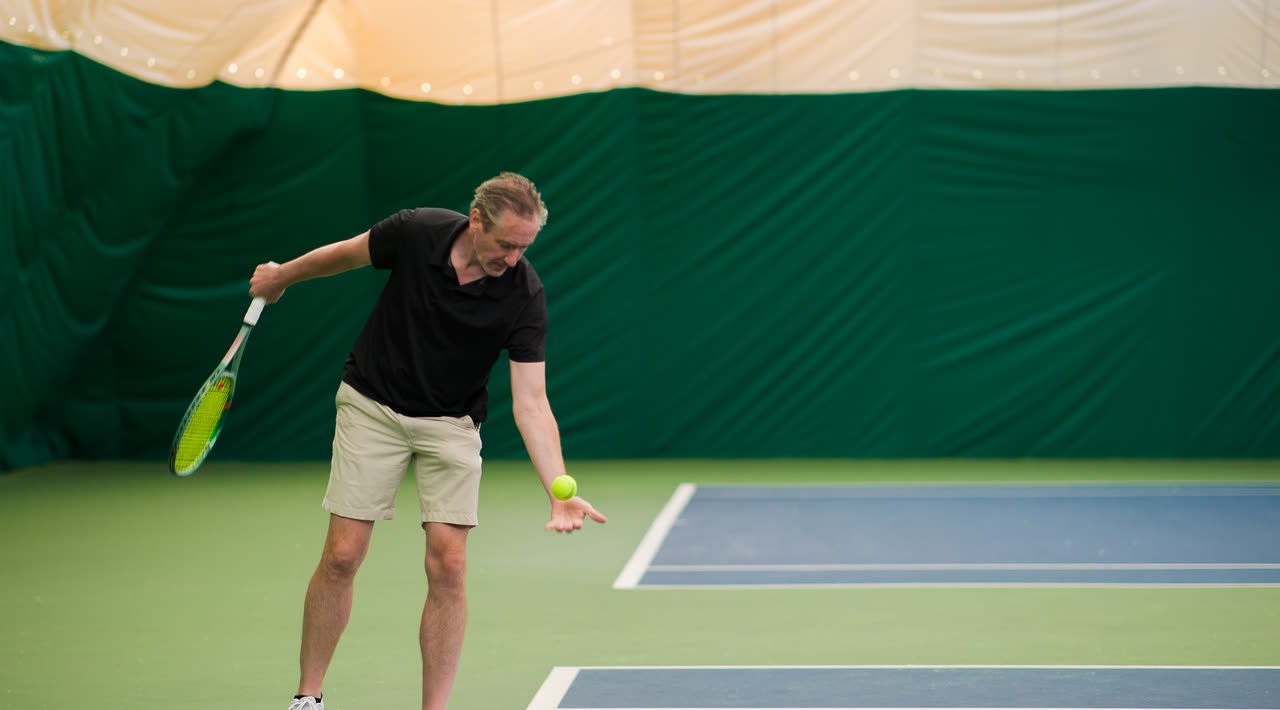
Anything that has to happen on a set day is a better fit for a roof. A coach who is booked on Tuesdays at six cannot offer a rain date, and a league that plays on Thursday cannot postpone every time the forecast turns. Our courts are heated, and everything we run happens indoors, so a tennis lesson or an adult league night is a plan rather than a hope.
The hot months: July and August
July and August bring about 13 and 12 days a month at 90 degrees or hotter, and the afternoon is when it bites. June adds about 7 such days and September about 3. A day at 100 degrees or more turns up about once in a typical July or August.
Heat is not only discomfort. The USTA's Sport Science Committee warns that above 95 degrees a player can make up to 60 mistakes an hour, and that dehydration can hurt performance in less than an hour. If you do play outdoors in July, the same guidance says to drink consistently rather than only when you are thirsty, and to wear light-colored, wicking clothing and a breathable hat. Cooled air takes most of that away. It is the reason a 4 p.m. hour in July is a normal tennis hour in our building and a risky one outdoors.
Is indoor tennis faster than outdoor?
Not by itself: the speed of a court comes from its surface, not its roof. That surprises people who have heard the opposite from a coach, so here is where each idea comes from.
The surface sets the speed
The International Tennis Federation rates court surfaces by firing a ball at them and timing it before and after the bounce, then sorts them into five categories from slow to fast. As court builder Laykold explains the ITF scale, rougher surfaces slow the ball and higher-bouncing surfaces play slower. The test measures the surface, not the building, and the rating belongs to the surface.
What the roof really changes
A roof removes wind and sun. In a 2013 piece for the Daily Pennsylvanian, Penn men's coach David Geatz described indoor tennis as quicker and more first-strike, noting that outdoor wind interferes with ball trajectory and sun gets in players' eyes. A Penn player in the same story said outdoor play gives you more time. So treat “faster” as how the game feels, not as a measurement. It is one college program's view, and a teammate disagreed.
Myth
Indoor tennis is always faster.
Fact
Speed is a property of the surface, which the ITF rates. What a roof removes is wind and sun, so the ball does what you expect more often.
Myth
If it is nice out, indoor courts are pointless.
Fact
April through June and September through October are good outdoors by the numbers above. The case for a roof is reliability, not superiority.
Myth
Rain is a summer-storm problem.
Fact
Rain or melted snow of 0.01 inch or more falls on about 104 days a year in Kansas City, more than one day in four.
Surface and light: what to check before you book
Ask what the court is made of, then look up at the lights. Those two checks tell you more than a brochure.
Surface
Hard courts, clay and carpet all play differently, and the ITF scale exists because of it. Ask the club what the surface is and whether you will be playing on it in your first session. Ours are indoor hard courts. Wear trainers with a flat, non-marking sole, which is what we ask every first-timer to bring.
Light
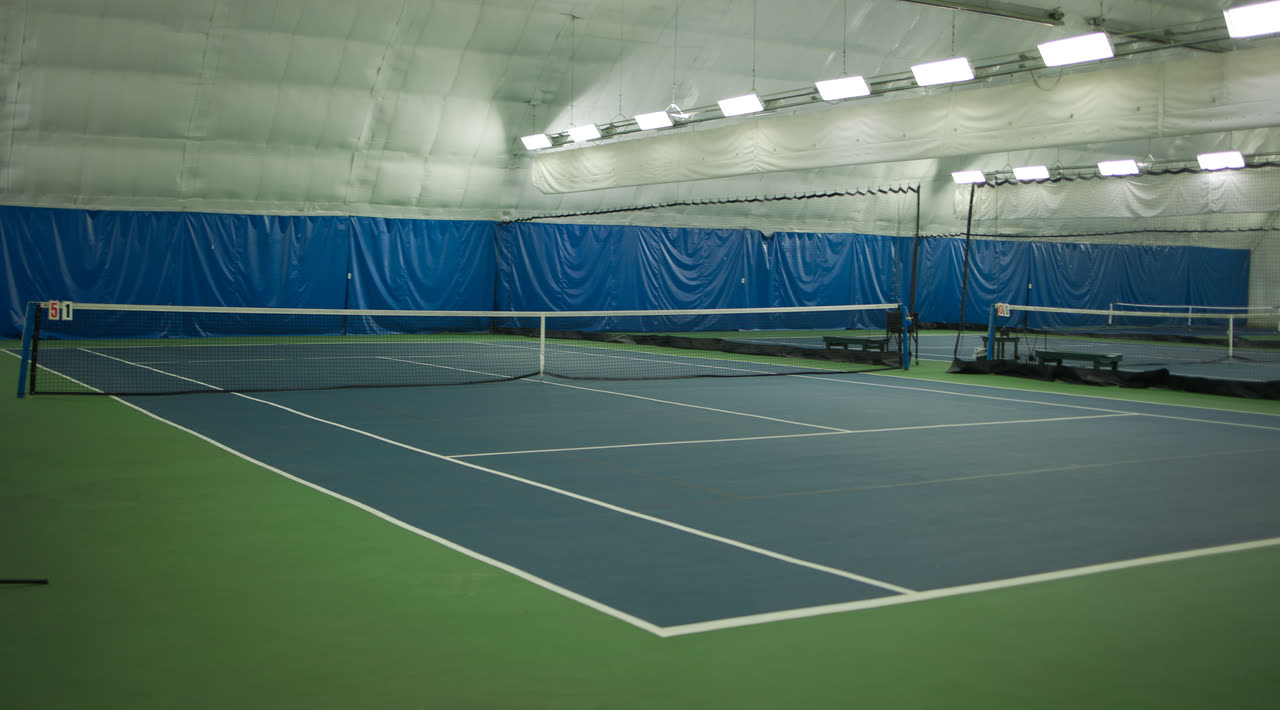
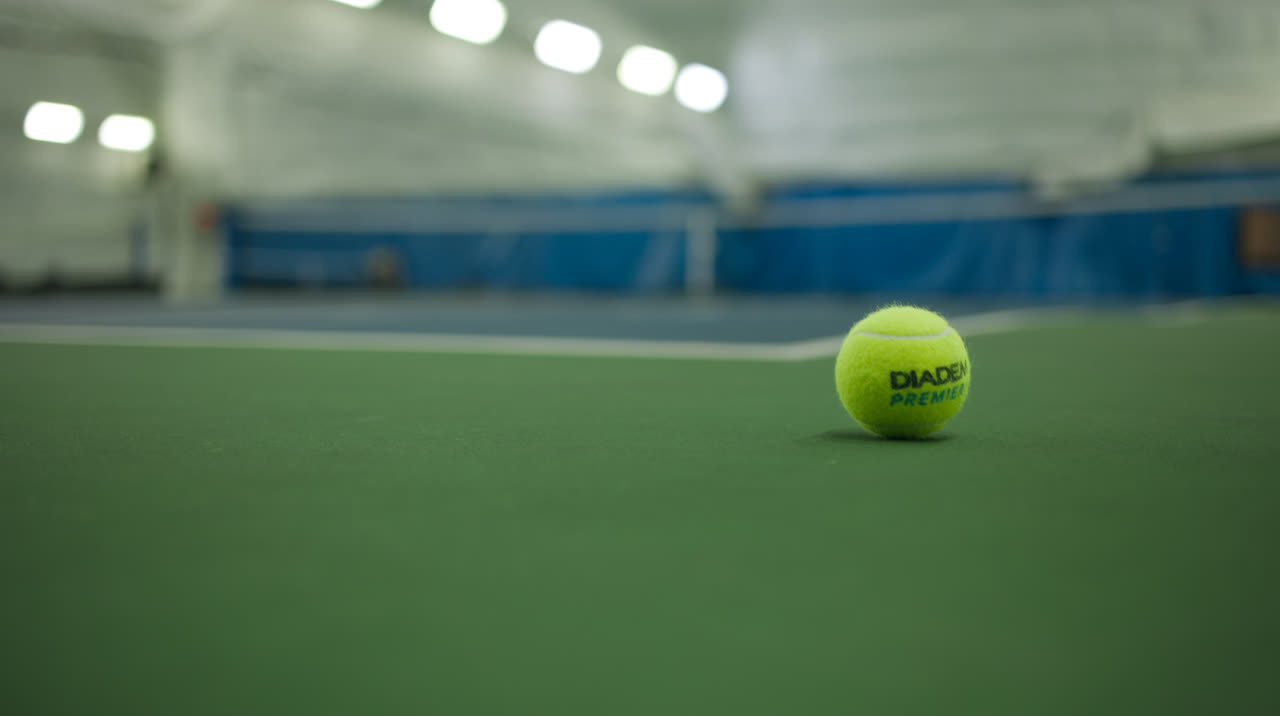
Overhead light should look even from baseline to baseline, and the ball should not disappear against the ceiling or the back wall on a lob. There is no sun to fight indoors, so a court that is evenly lit plays the same at 7 p.m. as at noon.
When the park is the better choice
April through June and September through October, a park court is a good choice and it is free. May is the wettest month by day count, with about 12 days of measurable precipitation, but a dry May evening is as good as tennis gets.
The limits are the ones you would expect. Nobody books you a slot, you need to bring your own partner, and a front that blows through ends the session. For the parks in our own area, read where to play tennis in Blue Springs. For courts elsewhere in the metro, the USTA has a facility search. The same logic holds for paddles, which we cover in indoor versus outdoor pickleball.
How to choose an indoor tennis club in Kansas City
Visit once, and ask six things before you commit to anything. Take the questions to any club, ours included.
- Can I book a court without a membership? Some clubs sell access only by membership. Others let you reserve by the hour.
- What is the surface? Ask what it is, and ask to hit on it once before you decide.
- Are the courts really heated and cooled? Not every indoor court is air conditioned, so ask rather than assume.
- Who coaches? Anyone coaching juniors should be USTA Safe Play approved, which means SafeSport training and a background screen.
- What are the ways to play? Booking a court is one. Lessons, leagues and weekly sessions are how you find people to play with.
- Can someone wait comfortably? A viewing area, parking and lockers decide whether a parent or a partner comes back.
Indoor tennis at Match Point KC
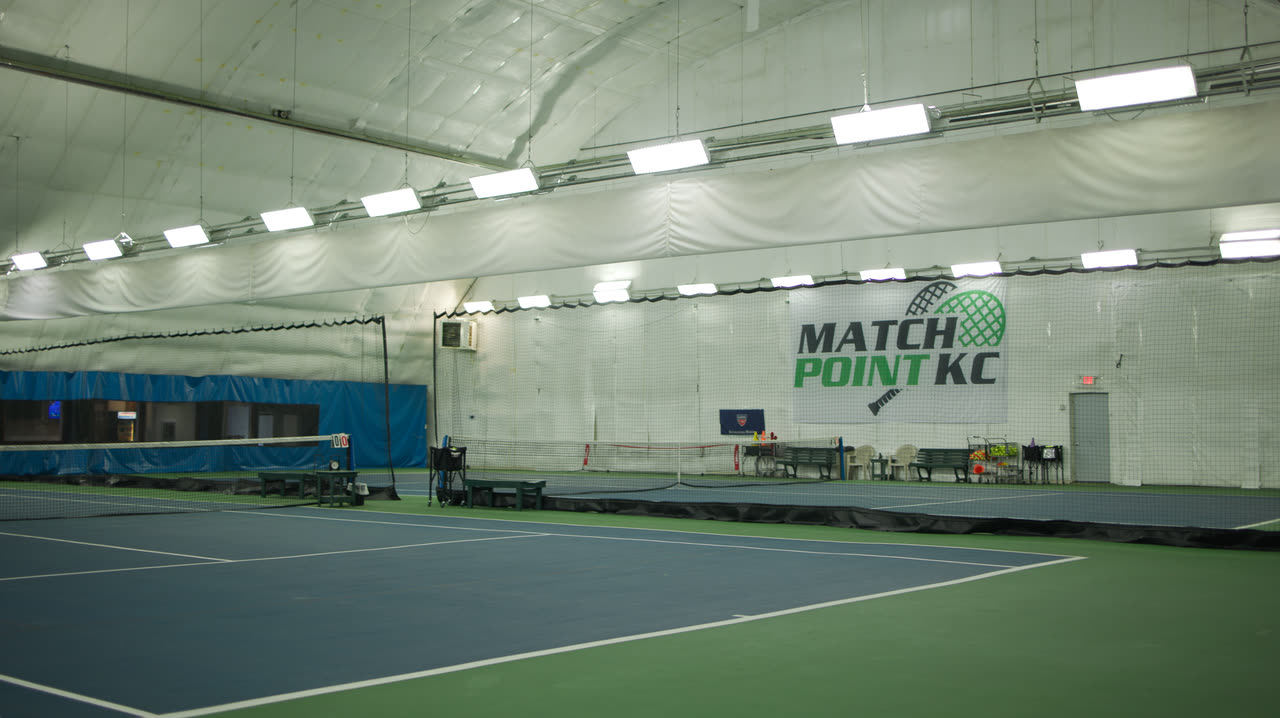
Match Point KC has four indoor hard courts in Blue Springs, heated and cooled, that anyone can book by the hour without a membership. That is the short version, and the rest is detail you can check against any other club.
The courts
4 tennis courts and 4 pickleball courts at 3109 NW Vesper Street, all heated and cooled indoor hard courts. Court time is booked online through CourtReserve, and the tennis page has the details. Racquets are available to borrow, and everyone signs a liability waiver before their first time on court.
Ways to play
You can book a court, take a private or group lesson, join an adult league or weekly adult activity, or enter a tournament. If you are working out your level first, our guide to finding your NTRP level and a league is a good next read, and anyone starting from zero should read how long it takes to learn tennis as an adult.
Hours and getting here
We are open seven days: 8:30am to 8:30pm Monday to Friday, 8am to 4pm Saturday and 8:30am to 3pm Sunday, with secure, ample parking on site. The lounge has a view of the courts and is open to everyone, whether or not you are playing that day. The hours and location page has directions.
Key takeaways
Winter and midsummer favor a roof. December through February and July through August are the clear indoor months in the NOAA numbers.
Spring and fall belong to the park. April through June and September through October are good outdoors, and free.
A roof does not set court speed. The surface does. A roof removes wind and sun, which changes how predictable the ball feels.
Ask six questions before you join anywhere. Booking rules, surface, climate control, coaching, ways to play and somewhere to wait.
Want to see it before you decide? Ask us or call (816) 224-7999, and the desk will tell you which hour is quiet.
Questions people ask
Are there indoor tennis courts in Kansas City?
Yes. Match Point KC in Blue Springs has four indoor hard courts, heated and cooled, open seven days a week. The USTA facility search lists other tennis facilities in the area, and it is worth calling ahead to confirm which ones are indoors.
Is indoor tennis faster than outdoor?
Not automatically. Court speed depends on the surface, which the ITF rates, not on whether there is a roof. Indoor play does remove wind and sun, and some college coaches say that makes it feel quicker.
What months are best for indoor tennis in Kansas City?
December through February for the cold and July and August for the heat, based on NOAA climate normals. March and November could go either way, and April through June and September through October are good outdoors.
Do I need a membership to play indoor tennis in Kansas City?
It depends on the club. At Match Point KC you can book a court by the hour through CourtReserve without a membership.
Is indoor tennis cooler in the summer?
Only if the facility is cooled, so ask before you assume. The courts at Match Point KC are heated and cooled, which matters in a month like July, when Kansas City averages about 13 days at 90 degrees or hotter.
What should I wear for indoor tennis?
Comfortable athletic clothes and trainers with a flat, non-marking sole. If you do not own a racquet, Match Point KC has racquets you can borrow.