

Many players wait until a string breaks to restring, and that is the wrong signal. Strings lose tension long before they snap, and the loss starts the day they go in. This guide answers how often you should restring a tennis racquet, with a physicist's rule you can test by ear, a checker built on published rules of thumb, and the questions to ask a stringer in Blue Springs, MO or anywhere else around Kansas City.
How often should you restring a tennis racquet?
At least once a year, and more often the more you play. That is the guidance of Rod Cross, a physicist at the University of Sydney, in his 2006 note on measuring string tension: the average player should restring at least once a year, depending on use, and a rule of thumb is to restring when the tension has dropped about 10 percent. He adds that professionals restring every day during a tournament. Coaches offer simpler rules based on how often you play, and the table lines three of them up.
| Rule | What it says | Who says it |
|---|---|---|
| Tension rule | Restring when tension has dropped about 10 percent. The average player should restring at least once a year, depending on use. | Rod Cross, University of Sydney Physics |
| Times a week | Restring as many times a year as you play per week, so once a week means once a year. | An older rule that Tennis Companion calls outdated |
| Double it | Restring about twice as many times a year as you play per week: once a week is every 6 months, three times a week every 2 months. | Tennis Companion, a tennis coaching site |
- typical tension lost between the pull tension and the finished racquet
- 30%
- tension lost when Cross says to restring
- 10%
- drop in pitch that goes with a 10 percent tension loss
- 5%
The first number is the surprising one. Cross and Bower measured the tension right after stringing and found it typically about 30 percent lower than the pull tension the machine applied, from a mix of stress relaxation, frame distortion and friction between the strings. That happens before you hit a ball.
What moves the answer: how you hit and how seriously you play
Tennis Companion lists three things that move you along these rules: how often and how long you play, your style, and your level of competition. A hard-hitting baseliner with a semi-western or western grip puts more friction and wear on the strings than a soft hitter who comes to the net a lot, so the baseliner restrings more often. As the stakes rise, consistency matters more, because you want the same tension every time and not a racquet that changes under you.
Why do strings go dead before they break?
Strings lose tension on their own, whether or not you play. Cross and Bower say tension decreases with time from stress relaxation even if the racquet is not used, and that it falls fastest at first: in one of their examples, a nylon string tensioned to 28 kg and clamped at a fixed length dropped to about 24 kg within 15 minutes. Bonds in the string that break under stress generally stay broken, so the loss slows over time rather than reversing.
String type changes the speed. Cross and Bower found that polyester loses tension more rapidly than nylon, and Tennis Companion's overview describes natural gut as best in class for holding tension and polyester as notorious for losing it fast, even though polyester is less likely to break.
| String | Tension maintenance | What it means for restringing |
|---|---|---|
| Natural gut | Best in class | Lasts longest, as long as it does not break. |
| Multifilament | A solid job | Comfortable feel, and it holds tension solidly. |
| Synthetic gut | Moderate | Needs more regular restringing. |
| Polyester | Loses tension fast | Less likely to break, so you replace it more often. |
Can you hear when a racquet needs restringing?
Yes, if you can remember what it sounded like when it was fresh. Pitch goes with the square root of string tension, so a 10 percent drop in tension is about a 5 percent drop in pitch. In Cross's example, a freshly strung racquet that pings at 600 Hz falls to about 570 Hz, a change he calls easy to pick by ear, provided you can remember what 600 Hz sounds like when you check your strings later. Drag the slider and listen.
Hear what lost tension sounds like
Fresh 600 Hz becomes 569 Hz, which is 5.1% lower.
Sound plays only when you press a button. These are plain tones, a stand-in for the ping of a stringbed, so a real racquet sounds different. Rod Cross says tennis strings typically vibrate between 500 and 700 Hz, and uses 600 Hz as his fresh example. The test is whether you can hear a gap this size, and whether you can remember how your own racquet sounded when it was new.
How to use it on your own racquet
The pitch of a racquet depends on head size, string thickness and material as well as tension, Cross notes, so compare your racquet with itself, never with someone else's. Tap the stringbed with a finger a day or two after stringing, once the quick early drop has slowed, and record a few seconds on your phone. Tap it again each month and compare by ear, or with a free tuner app. A pitch about 5 percent lower says about 10 percent of the tension has gone. It is a physicist's rule of thumb from 2006, not a manufacturer's standard.
Is it time to restring? Check your racquet
Answer four questions. The checker uses the rules above, and it will tell you when you do not need a restring yet.
Is it time to restring?
Your read
Not yet.
You are inside your window with no symptoms. Check again in a few weeks, or sooner if the ball starts flying long.
For how often you play, the rules of thumb say every 6 to 12 months. You are at 4 months. Synthetic gut and multifilament hold tension moderately well, so the middle of the window is a fair guess.
The window runs from Tennis Companion's doubled rule (short end) to the older rule of as many restrings a year as sessions a week (long end), and never past a year, which is Rod Cross's minimum for the average player. They are rules of thumb, not measurements.
Want a second opinion on your strings?
Tell us your racquet, your current string and how it has been feeling, and the club can tell you what it can do.
What are the signs your strings are dead?
The ball flies long, control and spin fade, your arm works harder, and deep notches or fraying show up where strings cross. Our racquet stringing page names two of them plainly: strings lose tension from the day they go in, the ball starts flying long, the arm starts working harder, and most players blame the swing. Tennis Companion fills in the rest.
- Control and spin fade. As polyester loses tension it loses resilience and snapback, which costs topspin, and a multifilament player loses pace and depth.
- More shock in the arm. Tennis Companion says dead strings send more shock to your arm and can aggravate an existing injury such as tennis elbow, so if comfort is a concern, restring more often.
- Deep notches. Strings rub where they cross. When the notches cut roughly half to three-quarters of the way through, it is likely time.
- Fraying. Natural gut, multifilament and kevlar fray as they wear, and heavier fraying is a cue to restring.
And a string that has broken settles the question.
What should you ask a stringer?
Ask for a recommendation and the reason behind it, because the reason matters more than the number. Six questions cover it.
- What tension range suits my racquet and my string? Tennis.com's string tension guide starts from a range for the string material, then adjusts for power, control and skill.
- Which string material fits how I play? Tennis.com says beginners benefit from the forgiveness of nylon, advanced players from the durability and control of polyester, and intermediates from a hybrid.
- Do I want more power or more control? Tennis.com says lower tensions tend to add power and higher tensions add control.
- What tension will you pull, and will you note it? Cross and Bower found the finished tension is typically about 30 percent below the pull tension, so a written record lets you change one thing at a time.
- Will you check the frame, grommets and grip? Our stringing page lists racquet inspection as a quick check for frame cracks, grommet wear and dead string.
- When will it be ready, and how will you tell me? Turnaround differs from shop to shop, so ask.
Where can you get a racquet restrung in Blue Springs, MO?
Match Point KC lists racquet stringing at 3109 NW Vesper Street in Blue Springs. Our racquet stringing page lists professional stringing, string recommendations, tension selection, grips and overgrips, racquet inspection and demo equipment, and it asks you to tell us your racquet, your current string and how it has been feeling so the club can say what it can do. Prices and turnaround are left off the page on purpose, so for stringing availability, pricing and how long it takes, call (816) 224-7999 or use the Request stringing form on the page.
The club's published hours are Monday to Friday 8:30 AM to 8:30 PM, Saturday 8 AM to 4 PM and Sunday 8:30 AM to 3 PM, and holiday hours can differ. Court time adds up on a stringbed. Our four indoor courts are heated and cooled and our tennis page calls the season twelve months long, so a player who stays on court through January should count those hours in the checker above. Our guide to indoor tennis courts in Kansas City shows month by month when players move inside.
When is a fresh set not the answer?
When you play a few times a year, or when your strokes are the problem. Cross's starting point for light players is once a year, and Tennis Companion says waiting for a break is perfectly fine for a casual player who hits a few times a year. Strings do not fix a swing, so if your tennis is stuck, a tennis lesson in Blue Springs will do more. Our guide to how long it takes to learn tennis as an adult covers how little gear a new player needs.
Key takeaways
Once a year is the floor. Cross says the average player should restring at least once a year, and sooner the more you play.
Strings die quietly. They lose tension from the day they go in, whether or not you play, and polyester loses it faster than nylon.
You can hear it. A 5 percent drop in pitch means about 10 percent of the tension is gone, if you remember the fresh sound.
Light player? Wait. If you play a few times a year and nothing feels off, a fresh set is not urgent.
Questions people ask
How often should you restring a tennis racquet?
At least once a year, and more often the more you play, according to University of Sydney physicist Rod Cross. His rule of thumb is to restring when tension has dropped about 10 percent. Tennis Companion suggests restringing about twice as many times a year as you play per week, so once a week is every six months and three times a week is every two months.
How do you know when your tennis racquet needs restringing?
The ball flies long, control and spin fade, your arm works harder, or deep notches and fraying appear where the strings cross. A string that has broken settles it. You can also check by ear: a 5 percent drop in pitch means about 10 percent of the tension has gone, which is Cross's restring point.
Where can I get my tennis racquet restrung in Blue Springs, MO?
Match Point KC's racquet stringing page lists professional stringing, string recommendations, tension selection, grips and overgrips, racquet inspection and demo equipment at 3109 NW Vesper Street in Blue Springs. Call (816) 224-7999 for stringing availability, pricing and how long it takes, or use the Request stringing form on the page.
Do tennis strings lose tension if you do not play?
Yes. Cross and Bower say tension decreases with time from stress relaxation even if the racquet is not used, and it falls fastest right after stringing. A racquet left in a closet for a year has older, looser strings than the day it was strung.
How soon do new strings lose tension?
Straight away. Cross and Bower found the tension right after stringing is typically about 30 percent lower than the pull tension, and in one example a nylon string tensioned to 28 kg and clamped at a fixed length fell to about 24 kg within 15 minutes. After that the loss continues at a steadily decreasing rate.
What should I ask a stringer?
Ask which tension range and string material suit your racquet and game, whether you want more power or more control, what tension they will pull and whether they will note it, whether they will check the frame and grommets, and when it will be ready. The reasons they give matter more than the numbers.
Keep reading

On the site
Racquet stringing in Blue Springs
Stringing, string recommendations, tension selection and racquet inspection. Call for availability, pricing and how long it takes.
Take a look
Related guide
How long to learn tennis as an adult in Blue Springs, MO?
Read it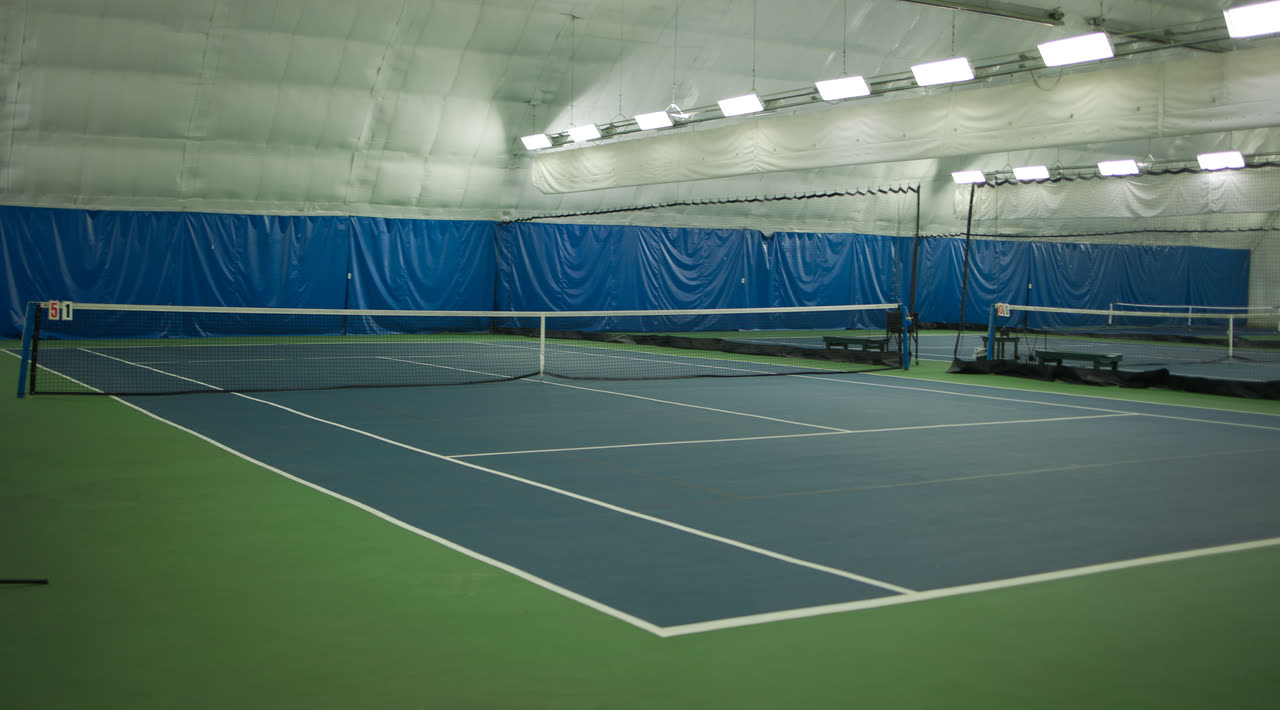
Related guide